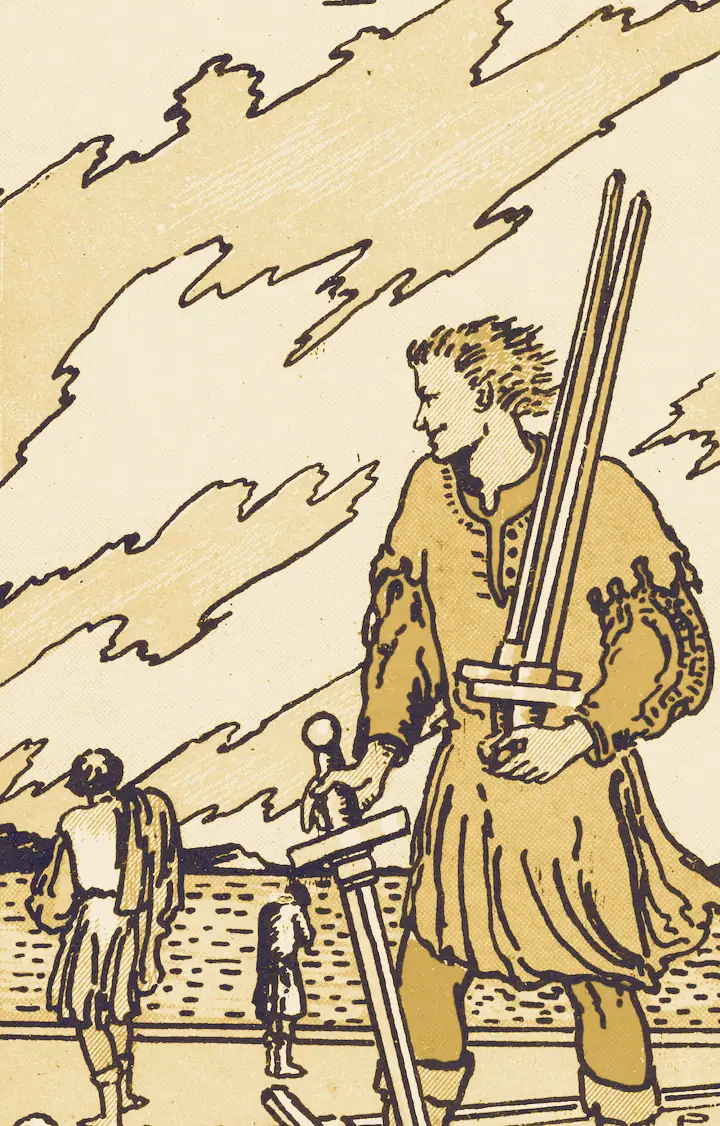
Five of Swords
Create or link your account to save favorite cards. Sign in
- conflict
- tension
- pride
- hollow win
- isolation
Overview
The Five of Swords is the card of winning and being left alone with the victory. It is that fight where you can be right, prevail and take the last word, but looking around you find the price was losing someone. When it appears, it usually points to a conflict where ego weighs more than the bond: the argument you have to win, the point you need to score, the pride that will not let you yield. Think of the time you won the argument and lost the friend. The Five reminds you that not every battle is worth fighting, and that sometimes the costliest victory is the one that leaves you holding the point with no one beside you.
Upright
A fight you can win, but at the cost of leaving someone in the dust. You are right and still you end up alone with it. Before you land the final blow, ask whether winning this round is worth losing that person. Sometimes being right costs a fortune.
Reversed
The moment to lower the blade, apologize, or walk away from a war that leads nowhere. Or the reverse: the cost of that hollow win finally reaches you and you look around with no one beside you. Drop the pride before it isolates you completely.
In love
An argument where you win the point but lose closeness. Proving who is right leaves you farther apart, not closer. Choose having peace over having the last word.
In work
Office politics, a win that turns half the team against you, a clash you take but that costs you allies. Before you force it, weigh the cost: being alone with the point does not always pay.
In money
In money matters, the Five of Swords warns of victories that cost you: the negotiation you win leaving resentment behind, the deal you push so hard the other side never returns. It can also speak of rivalry, dirty competition or playing hard for money that does not justify the wear. Upright, weigh the real cost before you force your way: sometimes giving a little pays off more than winning everything. Reversed, it may be time to admit that victory was hollow and repair the bond you broke to win a little more.
In health
For health, the Five of Swords speaks of the wear of living in conflict. The constant tension, the arguments that leave your body clenched, the stress of always having to win. That permanent combat mode takes its toll: poor digestion, loaded shoulders, broken sleep. Upright, the card asks you to lower your guard and choose your battles, because not everything is worth spending energy to win. Reversed, it is time to drop the pride and make peace, starting with yourself: carrying resentment weighs more than it seems.
Yes or no?
No, or at least not the way you hope. The Five of Swords brings conflict and hollow wins, so even if you win, the result leaves a bad taste. If what you want is to prevail, you might, but ask yourself first whether that victory is worth what you will lose for it.
The card's advice
Choose peace over being right. The Five of Swords asks whether winning this round is truly worth what it costs, because often being right and left alone with it does not pay. Before you land the final blow, look at who you are about to lose along the way. This is not about letting yourself be walked over, it is about not turning every friction into a war. Sometimes the smartest victory is the one you choose not to fight.
Symbolism
In the image, under a sky of torn clouds, a man gathers from the ground the swords others have dropped. He smiles with a look somewhere between satisfied and smug, like someone who has just won and is enjoying it too much. In the background, two figures walk away with heads down, defeated or simply tired of fighting. The ragged wind in the sky speaks of a tension not fully settled. The winner keeps the weapons, yes, but he is also left alone on the field. The card does not say winning is wrong, it says look carefully at what you won and at whose expense.
Astrological correspondence
Aquarius in its first decan, with Venus: the sting of winning at any cost. Venus, which is about bonds, is wounded here; the discord leaves someone out and the triumph tastes thin.
Combinations
With the Seven of Swords, the conflict turns dirty: someone plays with tricks or through the back door. With the Queen of Swords, the edge can cut too deep, so use the clarity to decide, not to wound. With The Tower, the fight erupts and something breaks beyond repair. Next to The Lovers or Cups, it usually speaks of a couple's argument where winning the point leaves you farther apart, not closer.
Frequently asked questions
What does the Five of Swords mean in tarot?
It is the card of conflict and the hollow win: you win the fight but lose something along the way, almost always a bond. It asks whether being right is worth being left alone with it.
Is the Five of Swords a negative card?
It usually is, because it speaks of discord, pride and triumphs that isolate. Upright it warns of the cost of winning at any price; reversed it opens the door to lowering the blade, apologizing and repairing.
What does the Five of Swords mean in love?
A fight where you take the point but lose closeness. Insisting on winning drives you apart instead of together. Sometimes peace is worth more than keeping the last word.
Does the Five of Swords mean yes or no?
It leans toward no, or a yes that tastes thin. You can prevail, but the card warns the victory will come with a cost that may not be worth it.