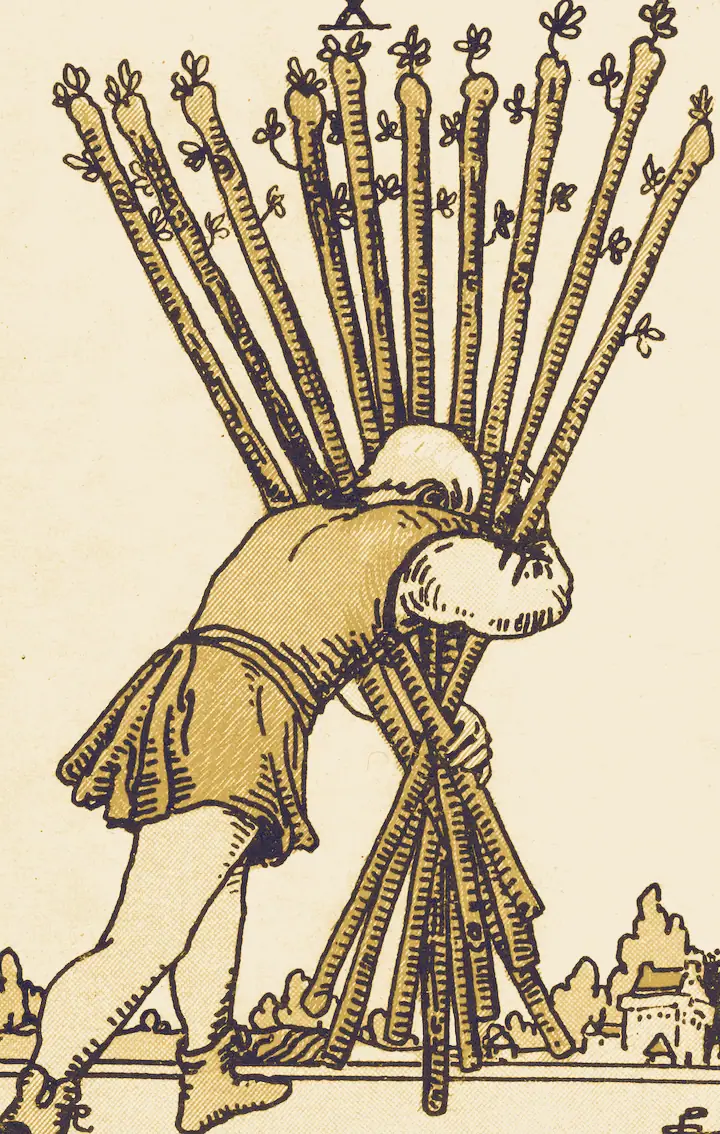
Ten of Wands
Create or link your account to save favorite cards. Sign in
- burden
- overload
- responsibility
- burnout
- weight
Overview
The Ten of Wands is the card of overload. You're carrying too much and every step weighs twice what it should. Think of the stretch when you said yes to everything (the favor, the extra task, someone else's problem) and now you haul it all alone on your shoulders. You're close to arriving, the goal is in sight, but you move bent over, barely able to look past your own feet. When it turns up, this card doesn't congratulate you for enduring so much: it asks how much of that weight is truly yours and how much you picked up along the way without noticing.
Upright
You're carrying too much. Ten staves in your arms, your view half blocked, home in sight but every step weighs a ton. You've been saying yes to everything and now you haul it all alone. You're about to arrive, but ask yourself how much of this is truly yours.
Reversed
Either you drop weight or you collapse. You start letting go of what isn't yours to carry, handing off tasks, saying no. It can also be the sign that you've hauled something for years that you can't bear anymore and it's time to set it down. You don't have to manage it all alone.
In love
The relationship has turned into one more obligation instead of a refuge. You carry almost everything: the plans, the problems, keeping spirits up. Talk about splitting the load before the fatigue puts out the desire. Loving shouldn't drain you this much.
In work
You've taken on more than you can hold: other people's tasks, responsibilities nobody else wants, a role that grew without warning. You deliver, but at your limit. Delegate, prioritize, and drop what isn't yours before you burn out. Arriving like this isn't worth it.
In money
In money matters, the Ten of Wands speaks of responsibilities that weigh more than they should: debts you drag along, other people's costs you take on, a job that pays but is squeezing you dry. Upright it warns that the current pace isn't sustainable even if the numbers add up. Reversed it brings the relief of starting to let go: renegotiate, delegate, say no to what isn't yours to pay. The underlying question is simple and hard: does this effort move you toward something, or does it just keep you afloat while it drains you?
In health
For health, the Ten of Wands is a clear sign of burnout from accumulation. The body has been warning you for a while (tension in your back, sleep that doesn't rest you, that fatigue that won't lift no matter how much you sleep) and you keep hauling as if it were someone else's problem. The card asks you to stop before the body stops for you. Letting go of weight isn't weakness: it's the only thing that keeps you from breaking down. Share what you can, say no to the next thing, and treat your rest as part of the work, not a reward.
Yes or no?
No. The Ten of Wands warns of overload, and its answer weighs toward no: as it stands, this will cost you more than it returns. It isn't a forever no, it's a no to keep carrying everything by yourself. Lighten the load first, then ask again.
The card's advice
Set down some weight before you collapse. The Ten of Wands reminds you that you don't have to manage it all alone, and that suffering in silence doesn't make you stronger, only slower. Look at that bundle you carry and separate what's truly yours from what you picked up out of habit or from not saying no. Delegate, ask for help, leave a stave or two on the ground. Arriving at the goal wrecked doesn't count as arriving well.
Symbolism
In the image, a man carries a bundle of ten staves pressed against his chest, so large it hides his face and barely lets him see the ground. He walks bent toward a town you can make out in the distance, the goal that never quite arrives. He carries all the staves at once, without spreading the weight or setting any down, as if dropping one meant giving up. There are no enemies around, and that's the key: no one loaded this on him, he loaded it on himself. The effort is real, but the price is seeing nothing beyond the next step.
Astrological correspondence
Third decan of Sagittarius, ruled by Saturn: the weight that slows a big vision. In your chart it's the burden of responsibility over what you began with excitement, the reminder that even fire runs out if it carries too much.
Combinations
With the Nine of Wands, fatigue piles on top of fatigue: a sign you've been holding on far too long without letting go. With The Hanged Man, the message is to surrender to the pause and finally set down what you can't hold. With the Ace of Wands, the weight of now contrasts with the spark of the start: reconnect with why you began. Next to the Four of Swords, the message is blunt: stop, rest, and recover before you pick the load back up.
Frequently asked questions
What does the Ten of Wands mean at work?
That you've taken on more than you can handle: other people's tasks, a role that grew without warning, responsibilities nobody else wants. You deliver, but at your limit. It's time to delegate and shed what was never really yours to carry.
Is the Ten of Wands a negative card?
It isn't negative, it's a warning. It acknowledges your effort but points out that the weight is unsustainable. Read well, it's an invitation to share the load before it costs you.
How do you get out of the Ten of Wands?
By setting down weight: delegate, ask for help, say no, and tell apart what's yours from what you carried out of habit. The reversed card is exactly that moment of starting to lighten up.
Does the Ten of Wands mean yes or no?
It leans toward no, or at least a no as things stand now. Before moving forward, the card asks you to lighten the load; with less weight on you, the answer can change.